Tenzin Dolma (PhD)
At the “China In The World 2026” summit in Taipei on July 7, Taiwanese Vice President Hsiao Bikhim expressed deep concern over the self-immolation of Tibetan activist Loga Rangzen, a tragic outcome of the repressive Chinese policies. The Ethnic Unity and Progress Law had come into force on July 1, 2026. The next day, Loga Rangzen self-immolated outside the United Nations headquarters in New York as his final act of protest.
Born in Karze, Kham, eastern Tibet, Lobsang Palden, popularly known as Loga Rangzen, fled as a refugee to India while young, and later immigrated to the United States, where he worked as a cab driver in Queens. Once a Buddhist monk in his youth, he served as the President of the New York-New Jersey chapter of the Tibetan National Congress. On July 2, 2026, at fifty-two, wearing his traditional Tibetan attire chupa, he planted the Tibetan National flag on the intersection of 1st Avenue and 42nd Street, near the United Nations Headquarters in New York City, and self-immolated.
It was the first Tibetan self-immolation outside Tibet, India, and Nepal. Pawo Thupten Ngodrup carried out the first recorded act in New Delhi in 1998. Loga Rangzen’s death brought the number of known Tibetan self-immolations to more than 170. Nearly all other self-immolations happened far from Western cameras. This time it grasped the headlines as it happened near the UN – the absolute pillar of international justice and human rights.
The Education of Erasure
The law, though framed around “unity,” operates under a guise that strips away community rights to language, religion, and identity, strategically driving cultural genocide and forced assimilation. It expands Chinese language mandates across regions with large non-Chinese populations such as Tibet, Xinjiang, and Inner Mongolia, and pushes what Chinese authorities describe as a unified national identity, one in which “ethnic unity” functions as a euphemism for the erosion of everything that makes minorities culturally distinct in terms of their language, culture, memory, and identity.
With this law in force, China has formalized a decades-long trajectory. Tibetan children are removed to state-run colonial boarding schools for re-education and forced sinicization, and Tibetan language schools have been shut down. What changes with this law is not the practice itself, but its status: it is no longer administrative policy or a rumor whispered out of Tibet; it is now the language of statute.
The Ethnic Unity Law is the near-total inverse of what China has spent decades promising. China ratified the UN Convention on the Rights of the Child in 1992, a treaty that protects a minority child’s right to their own language. China’s own law on Regional Ethnic Autonomy promises linguistic autonomy, and its white papers have repeated the same claims- the 2004 report said Tibetans held “legal” status as the principal language of instruction, in 2013 they emphasised bilingual education, and the 2025 report insisted that Tibetan language rights remain “guaranteed”. However, the new law calls for patriotic education, the primacy of Chinese culture, Chinese language as the standard language embedded in curricula and public life.
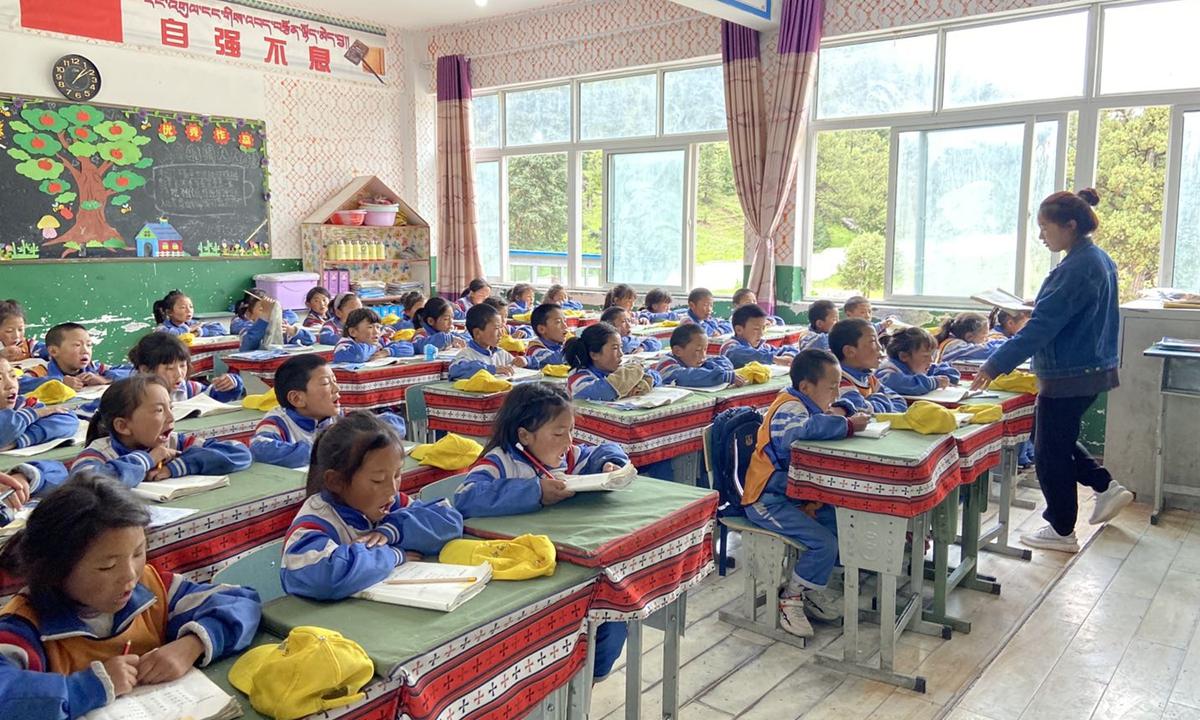 The push for the Chinese language starts before a child can read. An estimated 800,000 to 900,000 Tibetan children currently enrolled in colonial boarding schools often return home unable to speak Tibetan properly and showing less interest in their own culture. Parents who don’t send their children risk losing government benefits and job opportunities.
The erasure does not stop at graduation. Job applicants from the Tibet Autonomous Region require denouncing the Dalai Lama, and passing a political review, while fluency in the Chinese language gatekeeps the requirement for public-sector employment. A Tibetan child, in other words, is now made to lose their religious freedom and language in the classroom and then made to prove their loyalty in the Chinese language to get a job.
Cincinnati Mayor Aftab Pureval, who is himself of Tibetan heritage, linked Loga Rangzen’s death directly to decades of erosion in Tibetan language, religion, and education, now formalized by the new law. Loga Rangzen spent his life resisting exactly this; he expressed deep frustration over the destruction of Tibetan identity by China. His testimony, recorded in his own words at a time and place he deliberately chose, near the institution meant to hear exactly this kind of grievance. That clarity is what made his last protest a wake-up call rather than another statistic folded into the count of 170. His final act of protest cuts through years of China’s misinformation and disinformation about Tibetan identity and its protection. He calls for Tibetans across the diaspora to stand in solidarity and fight for Tibet’s independence.
A law that trains a four-year-old’s tongue into a foreign accent, empties their memory of their own grandmother’s language, is not unity. The Tibetan identity is not erased in one stroke; it is happening in the name of “unity”, education, and better opportunity euphemism. It is the quiet, bureaucratic erasure of an identity, and it deserves to be named exactly that.
Tenzin Dolma, the author of the article, is a research fellow at the Tibet Policy Institute.
PS: The views expressed here of the author and do not necessarily reflect those of the Tibet Policy Institute.
The original article was published by Cadal and Perfil https://www.cadal.org/publicaciones/articulos/?id=18181 and https://www.perfil.com/noticias/elobservador/tibet-y-china-lo-que-realmente-significa-la-unidad.phtmlPerfil is considered a mainstream Argentine news outlet.