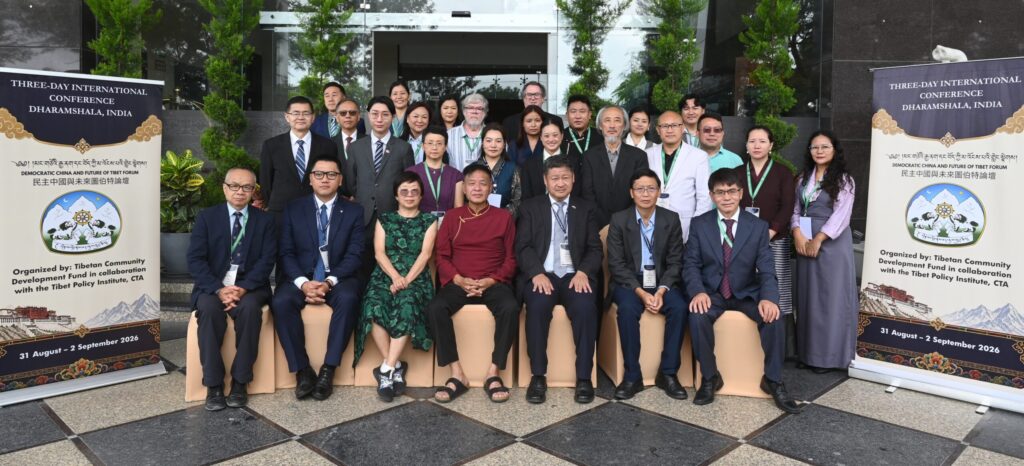
Dharamshala, September 2, 2026: Organised by the Tibetan Community Development Fund (TCDF) in collaboration with the Tibet Policy Institute (TPI), the three-day Democratic China and Future of Tibet Forum successfully concluded in Dharamsala bringing together 29 Tibetan and Chinese study scholars, experts and human rights activists from India, United States, Canada, United Kingdom, Germany, Netherlands, Australia, Japan, Taiwan, and Southern Mongolia.
The forum was convened to conduct candid and in-depth dialogue and exchanges on issues concerning democracy, human rights, and the future of Tibet, and to enhance mutual understanding and trust between Tibetan and Chinese people. Through sustained communication and pragmatic cooperation, the forum seeks to establish a credible and lasting partnership, while jointly exploring and advancing concrete nonviolent advocacy strategies and pathways toward democratic transformation, thereby building greater consensus for China’s democratization process and a peaceful resolution of the Sino-Tibetan conflict.
The Forum was inaugurated on August 31 with Sikyong Penpa Tsering delivering the keynote address on issues including Sino-Tibetan relations, the Middle Way Approach, the reincarnation of His Holiness the 14th Dalai Lama and the importance of cooperation between Tibetans and Chinese.
The forum culminated in five key declarations. These declarations addressed nonviolence, a shared democratic future, Tibetan democracy and history, the reincarnation of His Holiness the 14th Dalai Lama, and the legal implications of China’s so-called Law on the Promotion of Ethnic Unity and Progress.
The first declaration reaffirmed nonviolence as a common fundamental principle. Participants emphasised the importance of peaceful, practical and dialogical approaches to resolving the Sino-Tibetan conflict and recognised nonviolent resistance as a shared principle connecting the Tibetan and Chinese democratic movements.
The second declaration called for developing a common vision for a democratic future. Participants highlighted the importance of exchanges between Tibetans in exile and Chinese democracy organisations and individuals, promoting the democratic experience of the Tibetan community in exile, and supporting the broader process of democratization in China.
The third declaration focused on deepening understanding of Tibetan democracy, history, Tibetan-Chinese exchanges and the Middle Way Approach. The forum provided an opportunity for Chinese participants to learn about the Tibetan democratic system and Tibetan perspectives on history, while Tibetans gained greater insight into the Chinese democracy movement. Discussions also examined the Middle Way Approach and its relevance to a peaceful resolution of the Sino-Tibetan conflict.
The fourth declaration addressed independent Chinese perspectives on the reincarnation of His Holiness the 14th Dalai Lama. Participants unanimously confirmed that His Holiness the Dalai Lama and his Gaden Phodrang Trust designed by him has the final authority on the reincarnation and the Chinese authorities have no right to interfere, intervene or participate on this matter.
The fifth declaration examined China’s Law on the Promotion of Ethnic Unity and Progress from a legal and human rights perspective. Participants expressed serious concerns about its potential implications for the languages, cultures and identities of Tibetans, Uyghurs, Southern Mongolians and other ethnic communities, and called for the repeal of the law.
The final day of the forum, the participants attended the Tibetan Democracy Day at Thekchen Choeling Tsuglakhang. On behalf of the Chinese participants, Wang Dan delivered a speech and the Speaker of the Tibetan Parliament in Exile, Dolma Tsering Tekhang, launched of the book The Chinese Authorities Have No Right to Interfere on the Reincarnation of the Dalai Lama, a compilation of articles written by Chinese scholars and writers.
The forum concluded with closing remarks by TPI Director Tenzin Lekshay, and a commitment to sustain academic and policy dialogue and strengthen exchanges between Tibetans and Chinese. The five declarations adopted through the forum provide a framework for continued engagement, cooperation and nonviolent advocacy, while contributing to a broader vision of democratic transformation and a peaceful resolution of the Sino-Tibetan conflict.
– Report filed by Tibet Policy Institute, CTA