By Dr. Tsering Choedon
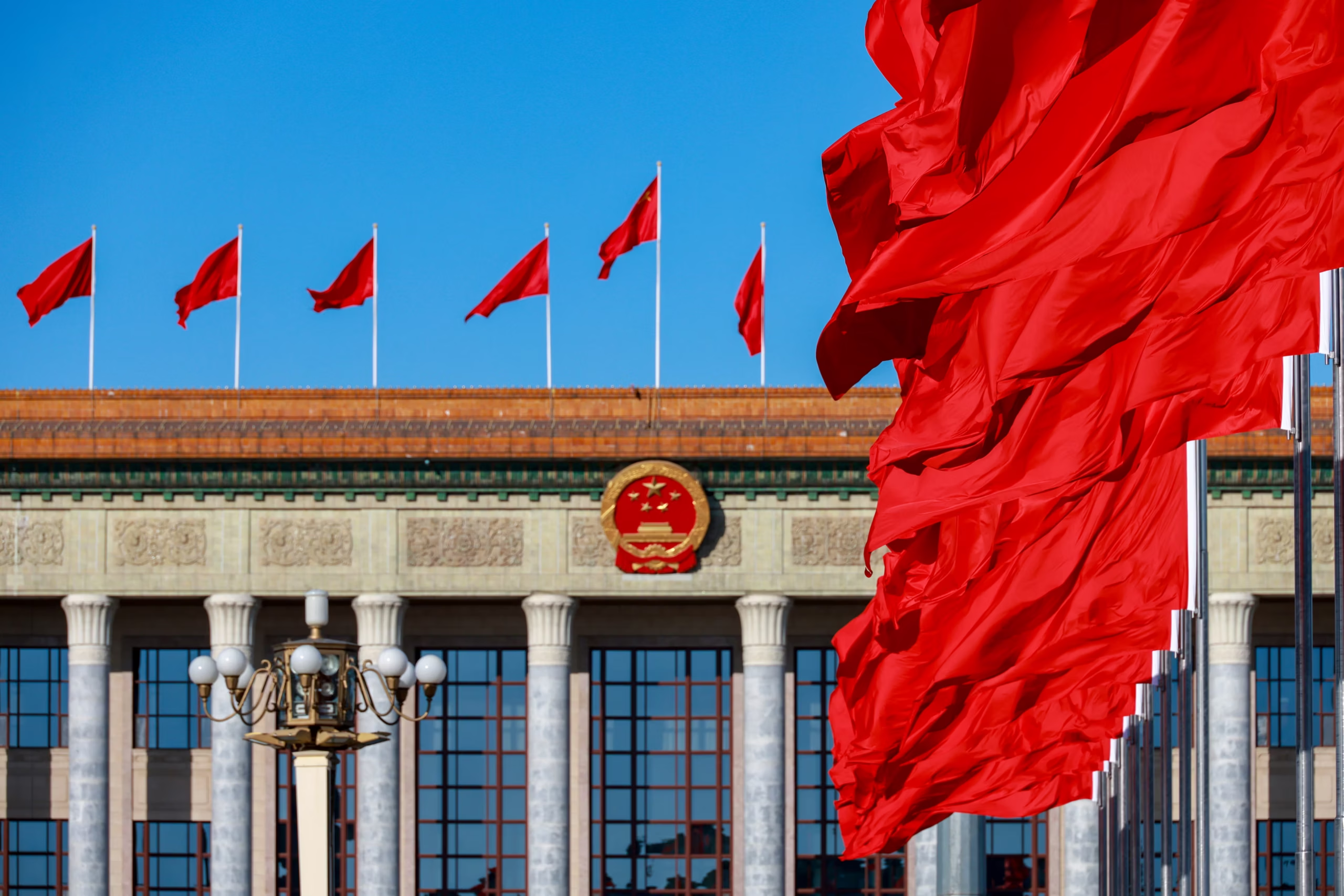
Photograph: VCG/Getty Images
China’s “Law on Promoting Ethnic Unity and Progress” is now in effect as of July 1, 2026. The name sounds benign — even aspirational. But for Tibetans, Uyghurs, Mongolians, and other ethnic minorities living under Chinese rule, the law represents something far grimmer: a permanent legal architecture for the destruction of their cultures, languages, and identities.
Passed by China’s National People’s Congress in March 2026, the law has already drawn condemnation from eight United Nations Special Rapporteurs, the European Parliament, and dozens of human rights organizations. Their alarm is warranted. This is not a law about unity. It is a law about erasure.
From Policy to Law: The Shift That Matters
China’s assimilationist policies toward ethnic minorities are not new. Under President Xi Jinping, what had once been a nominal framework of regional ethnic autonomy — inherited from the Mao era and loosely modelled on Soviet structures — has been systematically dismantled in favour of what scholars call “second-generation ethnic policies.” The goal, stated with increasing candor in official documents, is to “melt” diverse identities into a singular, homogeneous Chinese national identity anchored in loyalty to the Communist Party.
What is new about the 2026 law is that it enshrines this agenda in statute. Policies that were previously tested through provincial regulations in Tibetan and Mongolian regions — or implemented covertly, away from international scrutiny — are now binding nationwide obligations. What was once deniable is now law.
For Tibet, this distinction is not merely legal. It is existential.
What the Law Does
The law’s specific provisions reveal the breadth of its ambitions.
Chinese so called the common language is mandated as the language of education and official communication, directly undermining the protections for minority languages that had nominally existed under China’s 1984 Regional Ethnic Autonomy Law. For Tibetan — a language of unique literary depth, inseparable from Buddhist practice and Tibetan identity — this is a slow sentence of extinction.
The law encourages intermarriage between Chinese and “ethnic minorities” and requires mixed-ethnic residential communities, measures critics say are designed to dilute minority populations over generations. Schools and families are mandated to instil loyalty to the Communist Party in children. And authorities are empowered to prosecute anyone deemed to be promoting views harmful to “ethnic unity” — language so vague it could criminalize a Tibetan parent asking that their child be taught in their mother tongue.
Most alarming of all is the extension of the law’s reach beyond China’s borders. Article 63 provides a legal pretext for Beijing to target individuals abroad who “undermine ethnic unity or create ethnic division.” Given China’s documented record of transnational repression against diaspora Tibetans, Uyghurs, and Mongolians, this clause is not a theoretical threat. It is an instruction.
One Million Children
No single fact better illustrates the law’s true intent than this: an estimated one million Tibetan children have already been separated from their families and placed in state-run residential boarding schools. A UN Special Rapporteur on Minority Issues, presenting findings to the Human Rights Council earlier this year, described this system as part of a process of “extermination” of a minority group — and suggested the policies may qualify as genocide under international law.
The 2026 law does not create this system. It codifies and protects it. By giving legal cover to the boarding school apparatus and criminalizing resistance to it, the law transforms what human rights bodies have characterized as crimes into official state policy. This is not an escalation in degree. It is an escalation in kind.
The dismantling of Tibetan-led education did not begin with the 2026 law — it preceded and ultimately enabled it. Over the past few decades, Chinese authorities have systematically closed many privately run Tibetan schools, monastic institutions, and community-funded language programs, each shuttered through a different pretext but converging on the same outcome: the elimination of any educational space outside direct state control.
The pattern is traceable from the closure of Nyishur Ling School in 2013, after a teacher was arrested for what Beijing classified as political activity, through the 2018 banning of vacation-time Tibetan language classes at Khangmar Monastery School under laws prohibiting religious institutions from offering secular instruction to minors. By 2021, the campaign had accelerated: Sengdruk Taktse Middle School in Golog was shut without explanation, its students transferred into state-run residential schools, while monastery officials at Gaden Rabten Namgyal Ling were ordered to personally demolish their own school buildings within three days, ostensibly for violating land-use regulations. A cluster of community-funded language schools across Sershul County followed the same trajectory in late 2021 and early 2022.
More recent closures reveal an increasingly direct targeting of monastic education itself. In 2024, security personnel blocked off Taktsang Lhamo Kirti Monastery, evicted every student under eighteen, and mandated their enrolment in state boarding schools — the same year that Jigme Gyaltsen Nationalities Vocational School, an institution that had graduated over 2,200 students in engineering, medicine, and traditional philosophy, was shut under the vague justification of failing “updated provincial vocational educational standards.” The closures have continued into 2025 and 2026: Dorje Ten National Vocational and Technical School was forcibly shuttered in December 2025 with its principal detained by security forces, and the Gangjong Academy of Ancient and Modern Studies — founded to preserve traditional lineage learning alongside modern curricula — was permanently closed this past June after its administrators refused to incorporate Communist Party ideology into the syllabus.
What unites these cases is not their stated justifications, which vary by case, but their function: each represents an instance where Tibetan communities built independent capacity to transmit language, religion, or vocational skill outside the state system, and each was eliminated once that capacity became visible enough to threaten the assimilationist model the 2026 law now codifies. These closures are not isolated administrative actions but the groundwork for legislation — evidence that the law did not invent a new policy so much as formalize a practice already a decade in motion.
The Hinderance to Autonomy
For those who have followed Tibetan affairs closely, the law also carries a profound political meaning beyond its specific provisions.
For nearly five decades, the Central Tibetan Administration — the Tibetan government-in exile based in Dharamshala — consistently pursued what the Dalai Lama called the “Middle Way Approach”: for resolving the longstanding Sino-Tibet conflict, whereby seeking genuine autonomy for the Tibetan people within China rather than full independence, anchored in the belief that negotiated coexistence was possible. It was a policy of extraordinary restraint and pragmatic hope.
The 2026 law ends the space for Tibetan culture and self-governance — it legislates that space out of existence. This new ethnic law though framed on the basis of the Chinese constitution, negates the very foundations of autonomy that was enshrined in the constitution. Likewise, this new law also contradicts the law on Regional Ethnic Autonomy, which guarantees autonomous regions like Tibet the right to manage their internal affairs, preserve their language, and practice their religion free from undue interference. A law that legislates autonomy out of existence cannot coexist with a statute built to protect it — one effectively nullifies the other, even though both remain technically on the books. This internal contradiction matters beyond legal technicality: it exposes the gap between China’s constitutional commitments on paper and the practice of governance on the ground, undermining Beijing’s claim that the new law operates within, rather than against, its own legal framework.
The Global Stakes of a Domestic Law
What Beijing frames as an internal administrative matter is, in practice, a test case with consequences well beyond Tibet. International law functions only insofar as states believe its violation carries cost. A law that legislates a minority’s autonomy out of existence, ratified domestically and shielded by claims of sovereignty, offers every government watching a working template: codify what was once achieved through informal coercion, and the international community will register its objection through statements rather than sanctions. Uyghur established the method; Tibet confirms it as policy.
One of the primary concerns is the possible extraterritorial application of the law. If China claims the authority to prosecute actions or statements made outside its borders, foreign governments worry that their citizens could face legal consequences when traveling to China or territories under Chinese jurisdiction. This raises important questions about national sovereignty and the limits of international law.
Another major concern relates to freedom of speech and expression. In many democratic countries, individuals are free to discuss or advocate positions on politically sensitive issues such as Tibet, Taiwan, Hong Kong, or Uyghur. If China interprets some of these expressions as promoting separatism or undermining national unity, foreign academics, journalists, activists, and politicians may fear legal repercussions when entering China. Critics argue that this could discourage open debate and encourage self-censorship beyond China’s borders.
There are also more immediate diplomatic costs to consider. Governments hosting Tibetan exile communities — India, Nepal, and across North America and Europe — now face a constituency whose legal basis for negotiated return has been deliberately foreclosed, complicating decades of policy built around the Dalai Lama’s Middle Way framework. Meanwhile, states maintaining substantial trade and investment relationships with Beijing confront a sharpening question: continued engagement absent corresponding human rights conditions increasingly functions, in practice, as acquiescence rather than neutrality.
From an economic perspective, multinational businesses may face uncertainty due to conflicting legal and political expectations. Companies operating in China often need to comply with Chinese laws and policies regarding territorial integrity, while also adhering to the legal standards and public expectations of their home countries.
The law also raises concerns about academic freedom and international research collaboration. Universities, scholars, and research institutions may become more cautious when conducting studies or organizing discussions on politically sensitive topics related to China. There is concern that fear of legal consequences or restrictions on collaboration could limit open academic inquiry and international exchange of ideas.
Finally, the law has also generated human rights concerns. Some governments and international organizations condemned that broadly defined national unity laws may restrict freedoms of expression, association, and peaceful political advocacy. They contend that such laws could be used to suppress dis
sent. In contrast, the Chinese government maintains that these measures are necessary to protect national sovereignty, territorial integrity, and social stability, and that they target only activities threatening national unity.
By defending this law as standard “international practice”, China attempts to reshape global legal norms.
The International Response Is Not Enough
The international response, while welcome, has so far been insufficient to the scale of the challenge. Eight UN Special Rapporteurs have warned that the law risks violating the International Covenant on Economic, Social and Cultural Rights and the Convention on the Rights of the Child — both ratified by China. The European Parliament voted to condemn the law and call for its repeal. Rights organizations from across the world have demanded action.
But condemnation without consequence is a ritual China has learned to absorb. What is required now is pressure with teeth: targeted sanctions on officials overseeing forced assimilation programs, meaningful coordination among like-minded governments to raise Tibet in every bilateral dialogue with Beijing, and unhindered access to Tibet for independent UN human rights monitors — something China has refused for years.
Critically, the findings of the UN experts must be integrated into concrete diplomatic action, not merely filed as reports.
China insists that the law promotes “common prosperity” and national cohesion among its 56 recognized ethnic groups. It will argue that development has come to Tibet — and cite GDP figures to prove it. These claims deserve scrutiny. Economic growth extracted from a people who have been stripped of their language, separated from their children, and criminalized for practicing their religion is not prosperity. It is a transaction in which one party has no say.
The Law on Promoting Ethnic Unity and Progress enters into force on July 1. The date is not coincidental: it marks the anniversary of the founding of the Chinese Communist Party, asymbolism Beijing intends as a statement of permanence.
The international community has a narrowing window to treat this law as what it is — not a domestic governance matter, but a challenge to the foundational norms of cultural survival and human dignity that the post-war international order was built to protect. Tibet has survived occupation, exile, and repression for seven decades. Whether it can survive the legal erasure of its identity is now, partly, a question of whether the world is willing to act.
Dr. Tsering Choedon the author of the article, is a research fellow at the Tibet Policy Institute.
PS: The views expressed here of the author and do not necessarily reflect those of the Tibet Policy Institute.