
Huge photovoltaic parks, a power line to Guangdong, data centers, and copper mines suggest that Beijing’s green agenda on the plateau also serves strategic goals.
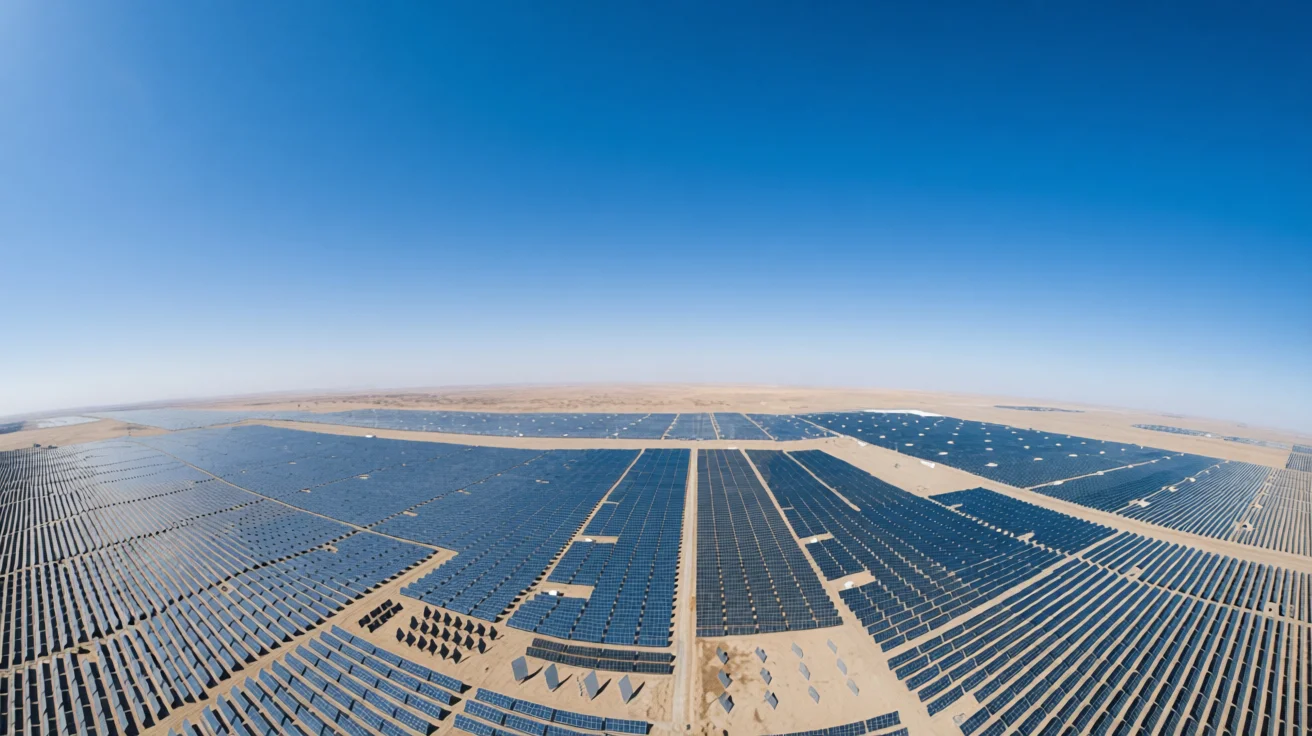
In September 2020, President Xi Jinping announced China’s goals of peaking carbon emissions before 2030 and achieving carbon neutrality by 2060. Since then, renewable energy development has expanded rapidly across the country. Tibet has emerged as one of the main energy bases in this transition. According to the “South China Morning Post,” researchers from the China Society for Hydropower Engineering and the state-owned Power Construction Corporation of China estimate that Tibet’s solar power potential could reach 10,000 GW. A “China Daily” report citing the recently published “China Energy Development 2026,” issued by the China Electric Power Planning and Engineering Institute, states that China supplies approximately 70 percent of the global market for wind power equipment and 80 percent for solar photovoltaic modules. As a result, Tibet will gradually become a center of exploration for China’s energy transition.
Chinese officials claim that this green expansion will generate local employment and improve livelihoods. State media frequently portrays massive solar installations as triumphs of ecological modernization and sustainable development. Yet the unprecedented scale of these projects raises broader, less visible questions: are these initiatives purely environmental, or do they serve deeper geopolitical objectives?
Several studies emphasize the social and economic benefits of photovoltaic solar energy in China. One study describes the Photovoltaic Poverty Alleviation Program as a new energy model that can reduce poverty by raising local incomes, improving the ecosystem, and lowering air pollution. However, this land-intensive model can also transform local landscapes, with potentially far-reaching consequences when the land is damaged. Although official accounts tend to emphasize its benefits, the model’s wider social and environmental impacts receive far less attention.
For instance, the Talatan solar farm in Gonghe County, Qinghai, historically part of the Tibetan region of Amdo, generates 21 GW of power and is presented by state media as a model of ecological restoration and local benefit. In addition, construction has started in the region on the world’s highest-altitude parabolic trough solar thermal facility. Furthermore, the five-year plan China launched this year outlines the construction of 300 energy bases. In short, solar energy projects are multiplying across Tibet.
According to a 2024 research paper published in “Scientific Reports,” construction of the Gonghe Photovoltaic Park began in 2012 and was completed in 2015, with an expected operating life of 20 to 30 years. It is currently considered the world’s largest photovoltaic power station. Chinese sources say the area previously suffered from severe ecological problems, including drought, desertification, and sandstorms. State media now claims that agrivoltaic practices have restored grasslands, supported animal husbandry, and benefited local herders. Overall, this official narrative presents the solar farm as a “win-win” project that turns barren land into a source of clean energy. Yet the scale of the project, several times larger than Manhattan, raises concerns about its necessity, sustainability, and long-term effects. Covering vast areas with solar panels inevitably alters landscapes, affects traditional livelihoods, and reshapes local economies.
In June 2025, Dr. Y. Nithiyanandam of the Takshashila Institution used satellite imagery and geospatial analysis to study the expansion of solar energy infrastructure across the “Tibet Autonomous Region.” The study documented the rapid growth of solar facilities in several areas, including around Shigatse Peace Airport. Since 2020, this area has seen a significant increase in solar infrastructure. Building solar facilities near military installations does not necessarily imply a direct connection with them. However, the development of these projects near strategically important locations in the “TAR” raises an important question: are they genuinely intended for renewable energy generation, as claimed, or do they serve wider strategic and geopolitical objectives?

If such huge projects are to be built in Tibet, Tibetans should have an equal right to make their voices heard. They should also be properly informed about how, when, and why such projects are launched in their areas.
This year, China started building an ultra-high-power transmission line from Tibet to Guangdong Province. It is scheduled for completion by 2029 and is expected to carry an amount of electricity equivalent to about half the annual output of the Three Gorges Dam. Once completed, it will transmit more than 43 billion kilowatt-hours of electricity each year from a renewable energy base in the “Tibet Autonomous Region.” The main feature of this transmission line is that the renewable electricity generated in Tibet will be sent to Guangdong and Shenzhen, which China describes as major industrial and manufacturing hubs, including for the artificial intelligence industry. This shows how Tibet’s energy resources are being used to meet the growing demand for electricity in parts of southern China.
In addition to leveraging Tibet’s renewable resources for large-scale power transmission, China continues to expand the use of renewable energy in its national data centers. Launched in 2022, the “Eastern Data and Western Computing” megaproject aims to use renewable energy resources from the western regions to support data infrastructure in the eastern regions. As part of this strategy, China is extending its supercomputing and digital infrastructure into Tibet. One notable example is the development of the Yajiang-1 computing hub in Lhoka, which is intended to support China’s growing ambitions in AI and high-performance computing. Together, these initiatives show how Tibet’s renewable energy resources are increasingly being integrated into China’s broader digital and technological development strategy.
This growing green infrastructure can therefore also be viewed through the lens of resource dominance. China has stepped up the exploration and exploitation of mineral resources across Tibet, including strategic and critical minerals.
Recent reports in the “South China Morning Post” point to an increase in critical mineral exploration in Tibet. According to these reports, at least nine strategic minerals found in the region rank among the top three in China in terms of known reserves. They also note that the privately controlled Xizang Zhihui Mining and the state-owned Zhaojin Nonferrous plan to develop gold, copper, and other critical mineral projects in Tibet. For example, copper is vital for power transmission lines and grids, so if energy demand increases, the demand for this critical mineral will rise accordingly.
Tibet has abundant copper reserves, and some of China’s largest copper mines, such as Gyama, Yulong, and Qulong, are located in the region. Since 2021, more than 20 million metric tons of copper resources have been discovered there. Copper is also one of several strategic minerals, alongside antimony and chromium, for which Tibet ranks first in China. The Yulong mine alone, for instance, produced 152,000 metric tons of copper in 2025.
Thus, China’s rapid expansion of critical mineral exploitation goes beyond green energy and the so-called environmental efforts it claims to pursue. It is also a strategic move to secure China’s position in the global minerals market and to control these critical resources.
Beyond these strategic implications, renewable energy development raises deeper concerns about its effects on local communities. Sanggay Tashi has described how solar development affects the people living near these projects. The planning of large-scale projects raises important questions about information, consultation, and participation. Do the affected Tibetans receive information in a language they understand? Are land-use arrangements transparent? Can pastoralists meaningfully influence decisions affecting their grazing areas, livelihoods, and culturally significant places?
In conclusion, few would dispute that solar power in Tibet produces green energy; the deeper question is whether it also serves other purposes. Although renewable energy projects in Tibet are framed as clean energy initiatives, their location, scale, and installed capacity warrant closer scrutiny.
*Mrs. Dhundup Wangmo, the author of the article, is a research fellow at the Tibet Policy Institute
PS: The views expressed here are of the author and do not necessarily reflect those of the Tibet Policy Institute
The article was originally published by Bitter Winter